Tier 2 · Digital Engineering · Star Industry
CONVERj

Trade studies in minutes, not weeks.

A converged trade-off engine for launch-vehicle and spacecraft architectures. One source of truth, coupled sub-system models, with ranked KPIs across every variant — built in-house at Star Industry.

One architecture JSON
Coupled convergence loop
Ranked KPIs across variants
SysON round-trip
CONVERj — architecture dashboard
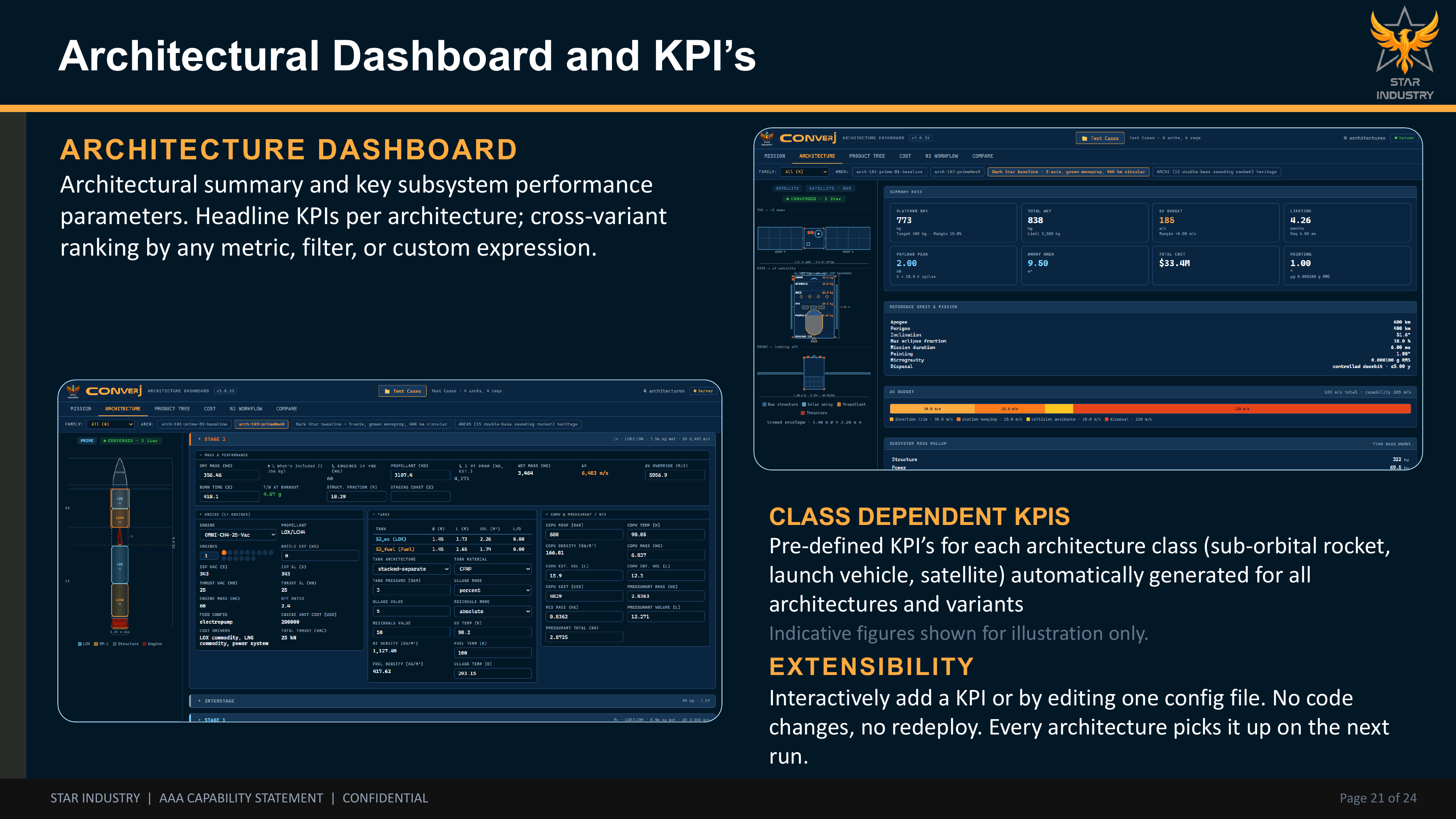
CONVERj architecture dashboard — headline KPIs per architecture with cross-variant ranking
Case Study · The Trade-Study Problem

Replace the workbook stack.

Architecture decisions hinge on coupled sub-system models. Running them by hand is slow, lossy and opaque. CONVERj replaces the workbook stack with one architecture JSON and one convergence loop — so trade studies run in minutes, not weeks.

Trade-study task
Excel workbook stack
CONVERj
Source of truth
Numbers copied by hand between spreadsheets. A single stale cell invalidates the study.
Single architecture JSON. Models read inputs via dotted paths, write outputs to owned sections.
Convergence loops
Tank sizing and COPV placement iterate against each other. No one has patience for it by hand.
Conductor runs the full chain to convergence. The optimiser names the violated constraint, not "failed".
Comparing variants
Ten architectures means ten workbooks. KPIs live in different tabs, different formats.
Cross-variant ranking by any metric, filter, or custom expression. Live in the compare view.
SysON alignment
The authoritative product tree and the workbook diverge within days of the last review.
Round-trip with SysON: import requirements, validate per loop, push the updated product tree back.
Worked Example · ARCAS

Sub-orbital sounding rocket. Converged in 3 minutes.

A 1959 USAF / NASA double-base solid sounding rocket. A heritage benchmark with documented apogee, mass and trajectory data — the right vehicle to back-check a Phase A trade-study toolchain. Architecture imported from SysON → full model chain → trajectory matched within 0.2 % of heritage data.

64 km
Target apogee
4.5 kg
Payload
85°
Launch elevation
Wallops
Launch site
As Imported · 238.5 km

First run overshoots.

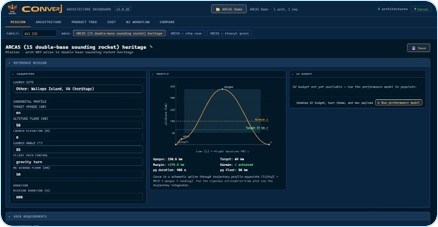
+174.5 km vs target. The configuration was sized for a different reference trajectory — CONVERj names the violated constraint, not just "failed". The optimiser converges from there.

ARCAS first-run trajectory in CONVERj — apogee 238.5 km, overshooting the 64 km target
// First run — 238.5 km apogee, target 64 km
Optimised · 64.1 km

Bisection finds the answer.

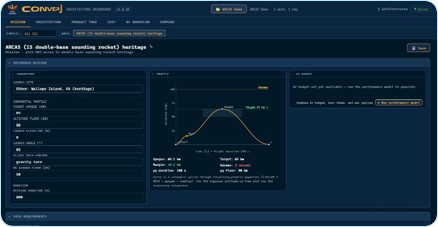
+0.1 km vs target. Bisection on a propellant scaling factor — full chain re-runs each iteration. Trajectory matched heritage data within 0.2 %. Inert mass scales sub-linearly (k0·85 default) — a one-line schema knob.

ARCAS optimised trajectory in CONVERj — apogee 64.1 km, matching the 64 km target
// Optimised — 64.1 km apogee, 0.2 % vs heritage
Compare & Trade-Off

Rank every variant. Live.

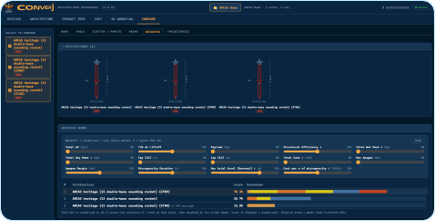
Run many architectures through the same convergence loop, then weight the KPIs that matter to your mission — mass, Δv, T/W, apogee, cost, microgravity, anything you choose. The ranking updates as you slide each weight, so the solution space is something you steer, not something you receive.

  • Cross-variant ranking by any metric, filter, or custom expression.
  • Live weighting sliders — explore the solution space against any priority mix without re-running.
  • Score breakdowns showing each KPI's contribution to the final ranking.
  • Add a new KPI by editing one config file; every architecture picks it up on the next run.
CONVERj trade-off view — multiple architectures ranked with weighted KPI sliders
// CONVERj — trade-off view
Engagement Model

Three phases. Clear scope.

Every engagement starts with a short scoping call, then moves to a fixed-price contract with binding deliverables — no open-ended retainers or T&M surprises. Scope and deliverables are agreed jointly before work begins. Indicative durations are for a typical launch-vehicle trade study; timelines flex to match your programme cadence.

Phase 1 · Scope & Seed
2 weeks

Ingest your mission requirement.

We ingest your mission requirement, stand up the systems-engineering baseline, and seed a candidate architecture. Outputs: scoping memo, initial requirements set, baseline architecture.

Phase 2 · Trade Study
4 – 8 weeks

Run every variant of interest.

We run the model chain across every variant of interest — propellant, staging, engine count. You receive ranked KPIs, convergence reports, and the live CONVERj dashboard.

Phase 3 · Handover
2 weeks

Your team keeps the output.

Your team keeps the repository. We train on conductor use, model authoring and the SysON round-trip. Ongoing support by retainer.

Three phases. Clear scope. Your team keeps the output.
Let’s Work Together

Bring your mission. Together we’ll
CONVERj
on your architecture.

Two-week scoping phase to translate your objective into a structured trade study — delivered as ranked architectures in CONVERj, with a trajectory and performance baseline attached.

Start Scoping Back to Star Industry